Dear Colleagues, Dear Friends,
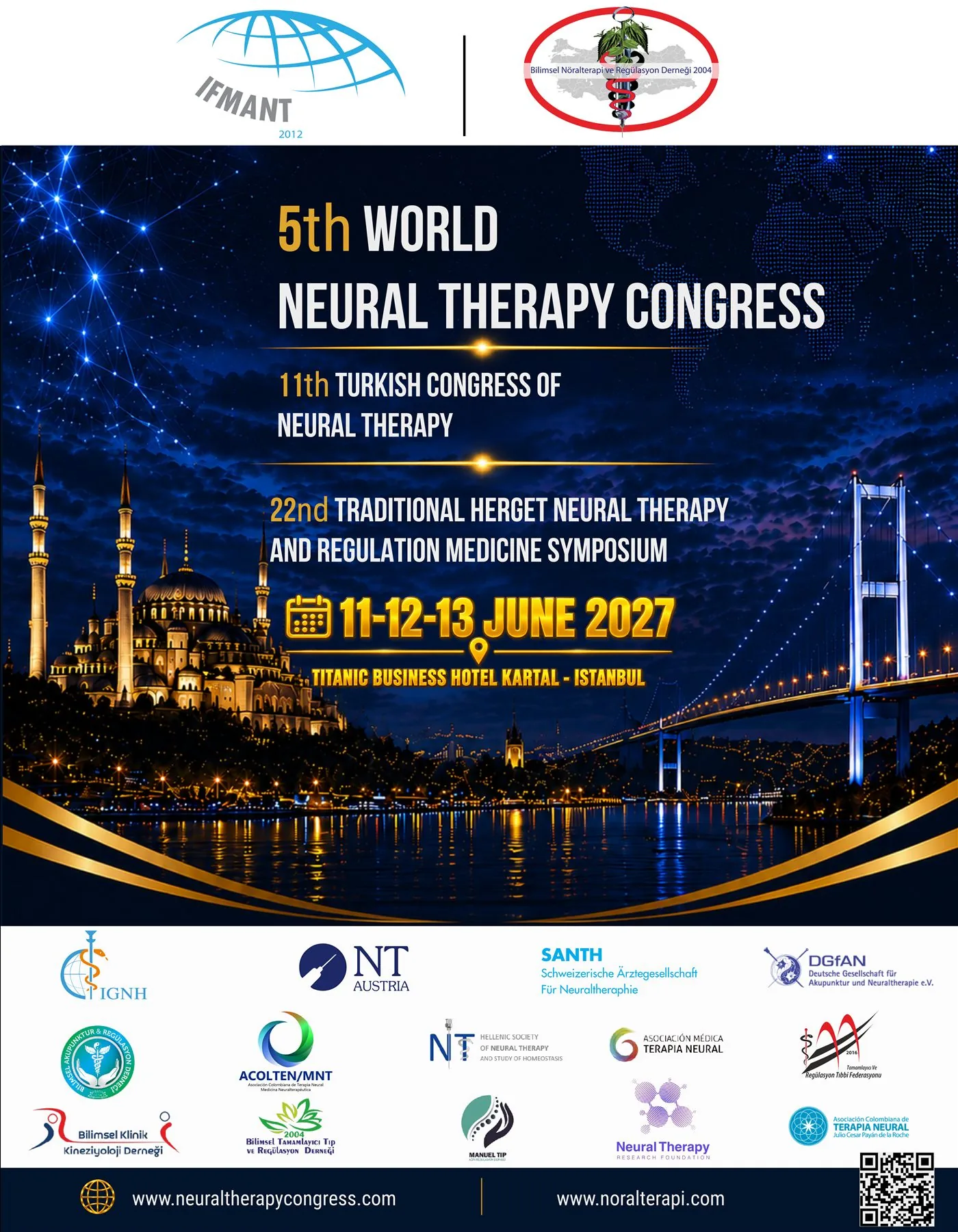
Once again, the international Neural Therapy community will come together in Istanbul. From 11 to 13 June 2027, we will host the 5th World Congress of Neural Therapy, together with the 11th International Congress of Neural Therapy in Türkiye and the 22nd Traditional Herget Symposium on Neural Therapy and Regulation Medicine.
For me, this gathering is much more than another congress. When we look at the journey of Neural Therapy from its origins to the present day, we see that the knowledge we have today is not the achievement of a single person, a single country, or a single school of thought. It has been shaped by generations of careful observation, clinical experience, scientific questioning, and, above all, the willingness to pass knowledge from one generation to the next. Every generation has added a stone to this foundation. Today, it is our responsibility to build upon it and carry it further.
From Clinical Observation to Scientific Understanding
When we look back at the intellectual roots of Neural Therapy, an important line of development begins with the early clinical observations of G. Spiess, who recognized that local anesthetics might have effects extending beyond anesthesia, including influences on inflammatory processes and wound healing.
Later, Prof. Dr. Gustav Ricker, through his concept of Relationspathologie, introduced a broader pathophysiological perspective. He proposed that a local process should not be understood as an isolated event within a single tissue but rather as part of a wider biological context mediated by the nervous system, particularly the sympathetic nervous system.
Then came the clinical observations of the brothers Ferdinand and Walter Huneke. Their unexpected observations of distant therapeutic effects following the use of procaine — particularly Ferdinand Huneke's observation, later known as the Sekundenphänomen — marked an important turning point in the development of Neural Therapy. One of the great contributions of the Huneke brothers was their courage to follow an unexpected clinical observation and ask what might lie behind it.
Science often progresses in precisely this way: first, there is careful observation. Then a question arises. And then begins the search for an explanation.
In the years that followed, Peter Dosch made an important contribution by systematizing the Huneke approach and helping transform accumulated clinical experience into a structured concept of Neural Therapy that could be taught and passed on. But the development of Neural Therapy did not end there. Each new generation continued to approach the questions left by the previous one with new knowledge and new scientific perspectives.
Herget and Bergsmann: Broadening Neural Therapy Towards Regulation Medicine
In my own medical and scientific development, Prof. Dr. med. Dr. med. dent. Horst Ferdinand Herget and Prim. Dr. Otto Bergsmann represent two particularly important links in this chain of knowledge and experience.
Herget taught me not to look at a patient only through the painful region, the affected organ, or the diagnosis. From him, I learned to consider Neural Therapy together with Manual Medicine, Pain Medicine, the intestinal system, connective tissue, and the functional relationships within the organism.
Otto Bergsmann added depth to this perspective with regulatory physiology. The organism is not simply a collection of independently functioning organs. The human organism is a dynamic biological network whose systems continuously communicate, influence one another, adapt, and strive to maintain their regulatory capacity.
This understanding takes Neural Therapy far beyond the concept of an injection treatment using local anesthetics. For me, this is precisely where Neural Therapy and Regulation Medicine meet. The symptom matters. But the symptom alone is not the disease. The essential question is why the organism can no longer regulate itself adequately.
A Legacy Carried Forward by New Generations
This scientific and clinical legacy lives on today. Among the living pioneers of Neural Therapy, Dr. Hans Barop has made an important contribution through decades of clinical experience, systematic teaching, publications, and the transmission of Neural Therapy knowledge to generations of physicians. Prof. Dr. Lorenz Fischer, in turn, has contributed significantly to strengthening the academic and scientific foundations of Neural Therapy, particularly through modern neurophysiology, the autonomic nervous system, pain physiology, segmental relationships, and scientific research.
Seen from this perspective, I do not regard the history of Neural Therapy simply as a sequence of individual names. I see it as a continuous chain of knowledge, experience, and transmission.
Spiess and his observations... Ricker and his pathophysiological thinking... the Huneke brothers and their clinical discoveries... Dosch and his efforts to systematize the field... Herget, Bergsmann, and their regulatory perspective... Barop, Fischer, and their clinical, neurophysiological, and scientific contributions... and now, the new generations who are taking responsibility for this heritage.
This is precisely why Neural Therapy remains a living medical approach. It does not merely preserve its past. With every generation, it is questioned again, investigated again, and developed further.
Istanbul 2027: Taking This Legacy to the Next Scientific Level
One of the central aims of the 5th World Congress of Neural Therapy is to bring this nearly century-long body of clinical and scientific experience together with contemporary knowledge and to take Neural Therapy to its next stage of scientific development.
We do not want to romanticize our past. But neither do we want to forget it. Because without knowing where we come from, we cannot clearly determine where we want to go. Tradition gives us our roots. Science gives us our future. In Istanbul, we want to bring the two together.
We want to create a scientific platform where modern neurophysiology, autonomic nervous system research, connective tissue and fascia science, immunology, biophysics, Pain Medicine, and Regulation Medicine can meet the accumulated clinical experience of Neural Therapy. And we want to do this not simply to repeat what we already know, but to ask together the questions we have not yet been able to answer.
Our Differences Are Our Strength
The Bogotá Congress once again showed us something very important. Neural Therapy has not developed in the same way across the world. Europe carries almost a century of clinical experience. Latin America, particularly the Colombian tradition, has developed a powerful perspective that views the human being as a complex, systemic whole. North America is bringing new momentum to the field through different clinical and scientific questions. Asia, meanwhile, has centuries-old medical traditions rooted in understanding the human being as an integrated whole.
We do not wish to place any of these traditions in opposition to one another. We see our differences not as a problem, but as a source of scientific richness.
This is precisely where the role of IFMANT becomes important. The purpose of IFMANT is not to reduce Neural Therapy worldwide to a single school of thought. Our task is to build bridges. To bring national societies closer together. To connect scientists and clinicians. To create opportunities for younger colleagues. To encourage collaborative research. To strengthen the quality of education and patient safety. And to ensure that Neural Therapy is represented on the scientific and academic platforms it deserves worldwide.
From Bogotá to Istanbul
Bogotá brought us together. Now, in Istanbul, we want to take this international collaboration one step further.
I warmly invite colleagues dedicated to Neural Therapy from Latin America, Europe, North America, Asia, and every other part of the world — as well as physicians, dentists, academics, researchers, Neural Therapy practitioners, and all colleagues interested in Regulation Medicine — to join us in Istanbul.
Bring your experience. Bring your knowledge. Bring your research. Bring your questions. And bring your critical thoughts and different perspectives as well.
Because science does not advance when everyone says the same thing. Science advances when people listen to one another, ask questions, challenge one another when necessary, and still remain together around the same scientific table.
Let us support one another. Let us learn from one another. Let us recognize our differences as a source of richness. And let us take Neural Therapy forward together.
A Shared Responsibility from the Past to the Future
Neural Therapy does not belong to one person. Nor does it belong to one country, one society, one school, or one generation. We received this knowledge from those who came before us. Our responsibility now is not merely to preserve it, but to question it, investigate it, develop it scientifically, and pass it on to future generations in a stronger form.
One generation observes. One generation questions. One generation develops. One generation passes the knowledge on. And then a new generation arrives and adds something new to what it has inherited. This is how science advances. This is how Neural Therapy has developed, and this is how it must continue to evolve.
For this reason, Istanbul 2027 is much more than a World Congress to me. It is a platform where the scientific and clinical legacy extending from Spiess to Ricker, from the Huneke brothers to Dosch, from Herget and Bergsmann to Barop and Fischer will meet the next generation.
With respect for our past, but with our eyes on the future... Preserving clinical experience, but never avoiding the questions of science... Maintaining our differences, while coming together around our shared values...
Let us meet under the umbrella of IFMANT — not to make one another think alike, but to learn from one another and to grow together. Let us meet in Istanbul, 11–13 June 2027. Let us continue together the scientific and human journey that leads from Bogotá to Istanbul.
To help Neural Therapy achieve the scientific recognition, academic visibility, and international standing it deserves, let us think together, investigate together, create together, and move forward together.
It will be a great pleasure and an honor for me to welcome you to Istanbul.
With my warmest regards,
Prof. Dr. Hüseyin Nazlikul
President of IFMANT — International Federation of Medical Associations of Neural Therapy
President of BNR — Scientific Society for Neural Therapy and Regulation Medicine